Historic documents can be incredibly valuable for genealogy research, but they’re often written in handwriting and language that make them hard for modern readers to understand. This is where AI becomes remarkably helpful.
The Challenge of Old Documents
Our ancestors lived in a different world with different vocabulary. Legal documents from the 1800s are particularly challenging because they include archaic legal terminology that’s no longer in common use, extremely long and complex sentences, relationships described in confusing ways, and property descriptions using measurements we don’t use anymore.
Even professional genealogists sometimes struggle with these documents. But what if you could have someone transcribe them for you, then translate them into plain English in seconds?
How AI Can Help
Asking AI to summarize a document in plain English is a great starting point for helping you understand challenging terminology. After reading a court case about my ancestor, I wanted to understand it better. I simply uploaded the document images to Copilot and received a detailed summary, including a case overview, a list of key issues raised, and the final decision.
Here are the simple steps you can take to start interpreting your own ancestors’ legal documents.
Step One: Transcribe the document.
AI tools are increasingly capable of reading old handwriting. Whether dealing with faded documents, unusual handwriting styles, or records where you can make out most words but get stuck on a few, you can photograph or scan the document, upload it, and ask for a transcription with any uncertain words flagged. Always verify against the original, but having a starting point is far better than staring at illegible script for hours.You can ask any LLM to help with this, or try ScribeAI from MyHeritage or Transkribus. I prefer to use Google AI Studio with this prompt:
Transcribe the uploaded document. Maintain line breaks. Put any word you don’t know in square brackets.
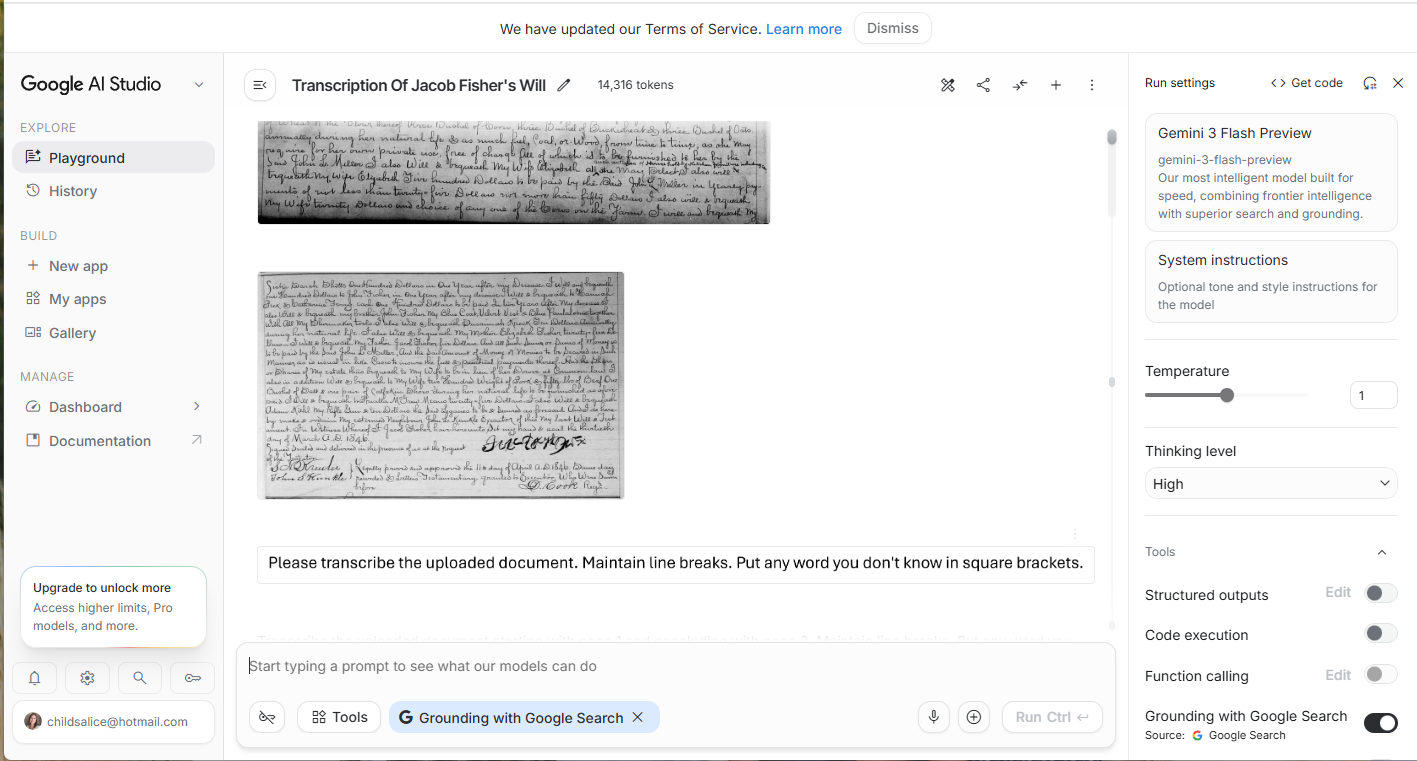
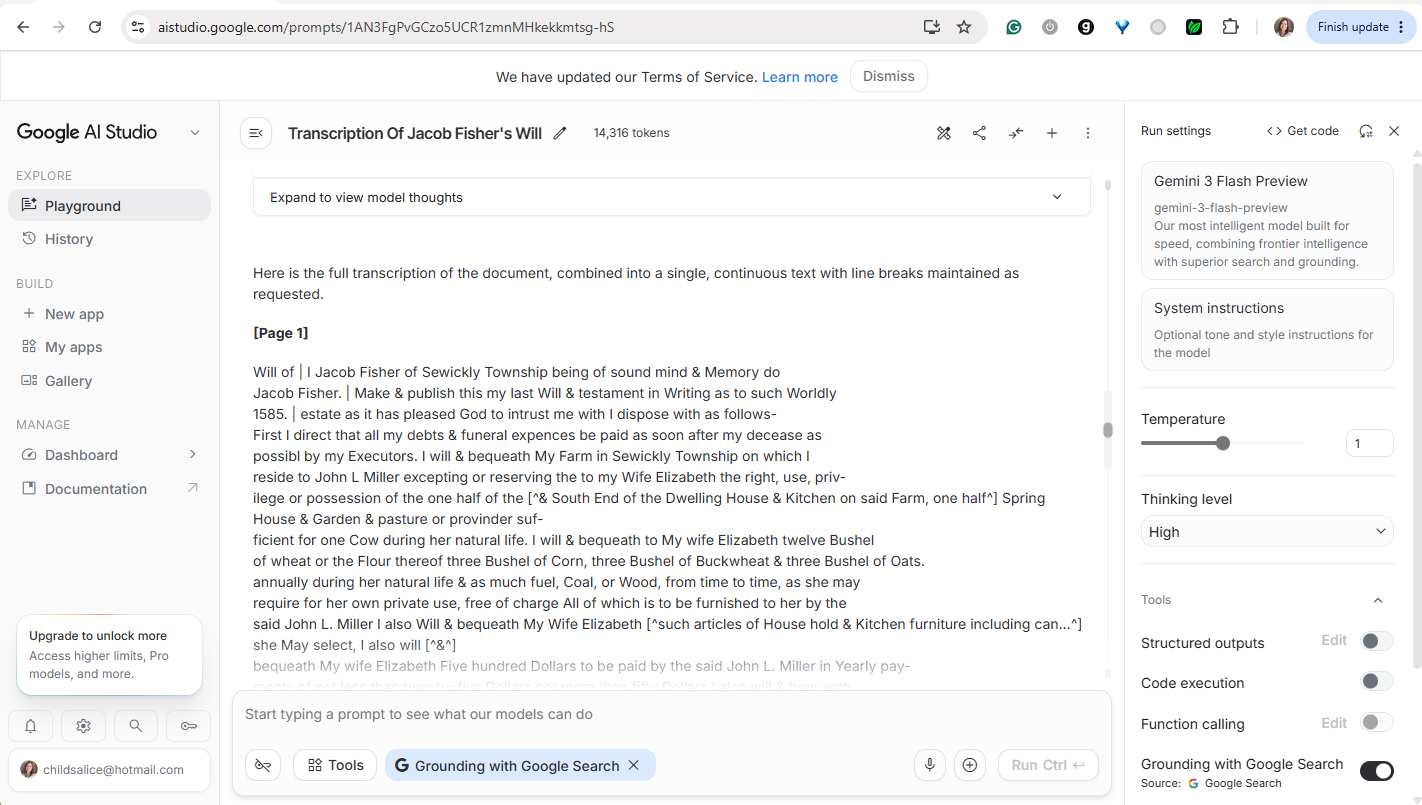
You can also use transcriptions from FamilySearch’s Full-Text feature if you find your document there.
Step Two: Request a Plain English Summary
Open your preferred AI tool and create a prompt that identifies your ancestor, asks for a plain English summary, and specifies what you want to understand — such as who receives what and any special conditions mentioned. Then paste in your transcription.
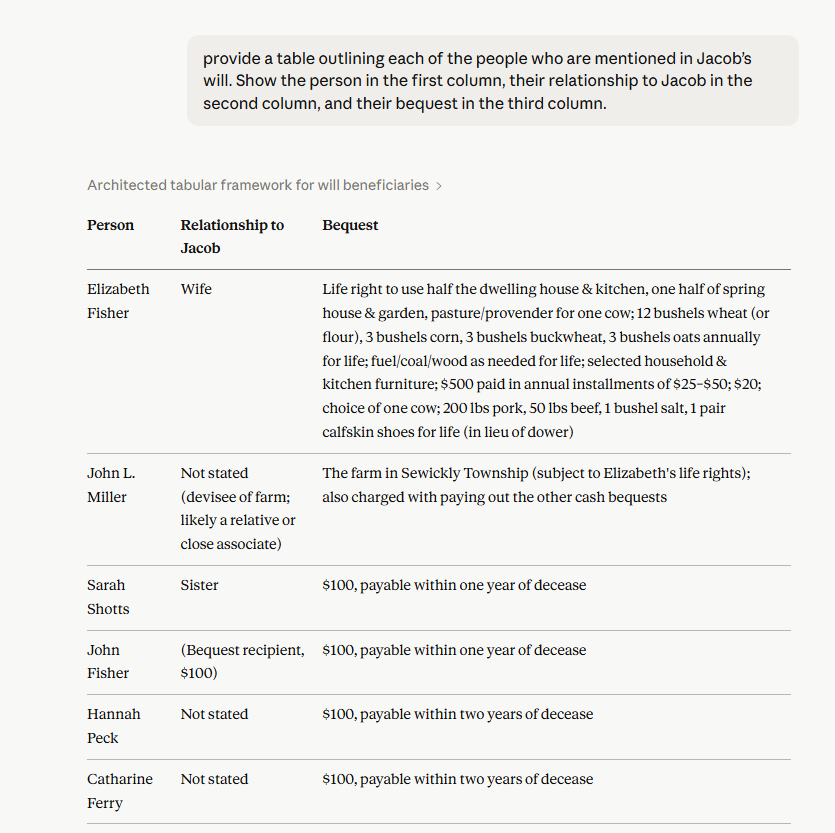
Within moments, you’ll receive a clear summary. But you can go further. Once AI understands your document, you can ask it to organize the information into helpful reference tools, such as lists of people mentioned or tables showing relationships and what each person inherited. This information can then be copied directly into your genealogy software, a research log, or a written work.
The Power of Step-by-Step Prompts
One particularly useful technique is “prompt chaining” — breaking your work into steps rather than trying to get everything in one request. You might start with a transcription request, then ask for a list of heirs, then convert that into a table.This approach gives you more control, allowing you to catch and correct errors before moving on.
Requesting Ideas for Future Research
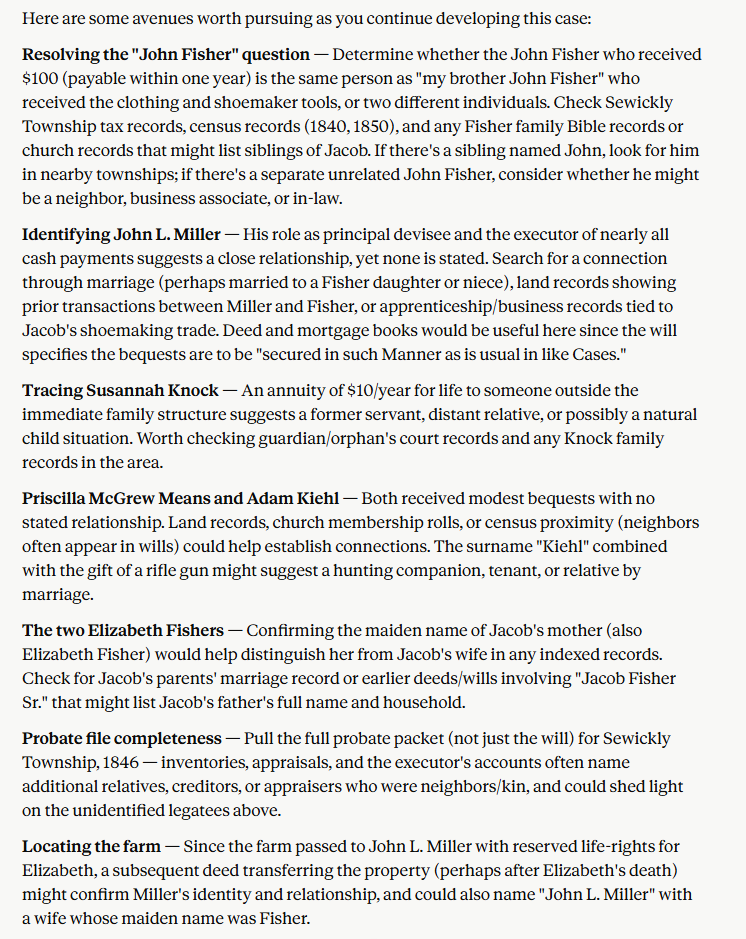
AI can provide suggestions for new avenues to explore. After asking Google AI Studio to transcribe Jacob Fisher’s will and Claude to provide a table of beneficiaries, I asked Claude to “Make suggestions for future research.” It came up with some great ideas! While I already know the answers to many of these suggestions, I have yet to identify Priscilla McGrew Means. This will be a fun project to tackle.
Maintaining Good Research Standards
Always remember that AI is a tool, not a replacement for sound genealogy practices. Always verify AI’s interpretation against the original document, save both the original and any AI-generated summaries, note in your research log that you used AI assistance, cite your sources properly, and use your judgment — if something seems incorrect, investigate further. AI makes mistakes, and your role as the genealogist is to catch errors and ensure accuracy.
This Week’s Challenge
Put AI to work on a real document this week. Find something that’s been frustrating you — a will, deed, or legal record — choose an AI tool and get started. Ask for a plain English summary, then create a reference table organizing the key information.
The documents that have been blocking your progress don’t have to remain barriers. With AI assistance, you can unlock their information and move your family history forward. What document will you tackle first?
Written by Alice Childs, with the assistance of Claude.ai.
